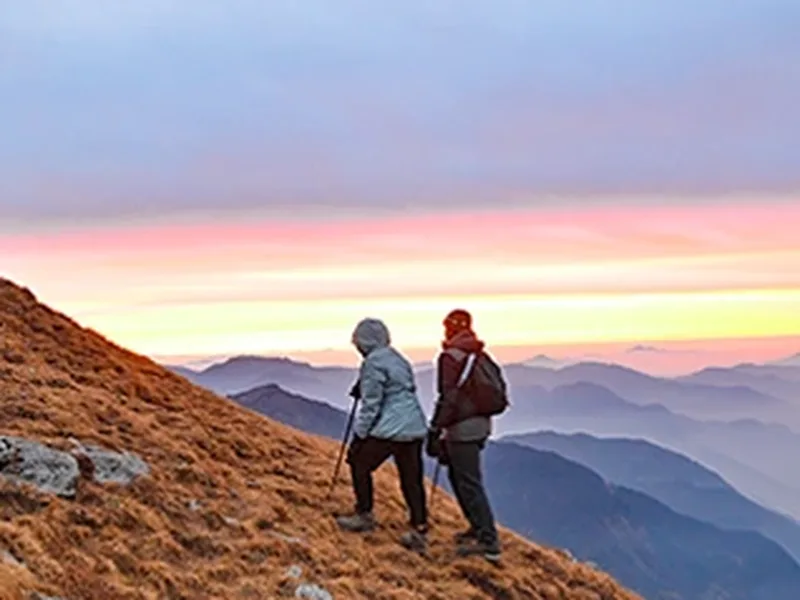
There is a persistent belief that trekking in Nepal means Everest Base Camp, three weeks, and suffering. The Annapurna foothills disprove all three: a four-day loop from Pokhara through stone-built Gurung villages, sleeping in teahouses, topping out at Poon Hill at 3,210 m, high enough for the sunrise of your life over two 8,000-metre peaks, low enough that altitude sickness is rare rather than expected. For an Indian passport holder there is not even a visa; you can decide in a fortnight and go.
What we do differently is refuse to pretend the trek is easy. It is a Demanding trip and we grade it so: four consecutive days of walking, ten to fifteen thousand of the famous stone steps, five to seven hours a day. In exchange we make everything around the walking soft, porters carry the main bags, teahouses are pre-booked so you are never racing for a room, and the trek is bracketed by Pokhara lakeside nights with hot showers and good coffee at both ends. Our escort walks the trail with you alongside licensed local guides, and the pace is set by whoever in your party is slowest, without commentary.
This is the journey we point at friends travelling together, colleagues and the under-35s who want an achievement rather than an itinerary, and at anyone who has stared at Instagram reels of Poon Hill sunrise and assumed it required more fitness than they have. It requires exactly as much fitness as three months of regular stair-climbing builds. We send a training note at booking and we mean it.
Nine days, start to finish. The trek is four of them.
Days 1–2Kathmandu & Pokharaarrive, lakeside briefing
Days 3–6The trekGhandruk to Poon Hill, 3,210 m
Days 7–8Pokhara & Kathmandurest, boating, farewell dinner
Day 9Departfly home from Kathmandu
- Day 1
Arrive Kathmandu, transfer, evening at Boudhanath stupa as the lamps come on. Easy on purpose.
- Day 2
Morning flight or scenic drive to Pokhara, afternoon by Phewa Lake, gear check and trek briefing over dinner.
- Day 3
Drive to the trailhead, trek to Ghandruk (4–5 hours), stone staircases, terraced fields, first teahouse night with Annapurna South filling the window.
- Day 4
Ghandruk to Tadapani (5–6 hours) through rhododendron forest, in March-April, an entire forest in flower.
- Day 5
Tadapani to Ghorepani (5–6 hours), the longest day, crossing ridgelines with Dhaulagiri appearing to the west. Early night.
- Day 6
Poon Hill for sunrise, headlamps on at 4:30, an hour's climb, then Annapurna, Machhapuchhre and Dhaulagiri turning pink in sequence. Descend to Ulleri/Hile, drive back to Pokhara, hot shower, celebration dinner.
- Day 7
Pokhara, lazy morning, boating on Phewa Lake, World Peace Pagoda at sunset. Optional paragliding for the unsated.
- Day 8
Return to Kathmandu, evening in Thamel for shopping and farewell dinner.
- Day 9
Depart Kathmandu.
The facts most itineraries leave out. We print them because they are what decides whether this trip suits you.
Where you stay
Comfortable lakeside hotels in Pokhara and a well-run Thamel-adjacent hotel in Kathmandu. On trek, teahouses: clean twin rooms, shared bathrooms, blankets provided, dal bhat that refills until you surrender. We book the better houses in each village and have used the same families for years.
Who it’s for
Friends travelling together, young couples and solo travellers, anyone reasonably fit who wants their first Himalayan trek done properly. Not for travellers who need attached bathrooms every night, and not for anyone unwilling to train a little: the steps to Ghandruk have humbled many a gym membership.